KORU is a hybrid air purifier and smart planter that leverages nature's air-purifying power alongside advanced filtration technology. Inspired by NASA research on plant-based air purification, KORU enhances indoor air quality through a multi-stage filtration system while also nurturing a living plant through automated watering and environmental monitoring. The Indiegogo campaign surpassed 1000% of its funding goal, raising over $110,000 USD.
Industry
Sustainable Design
Year
2020
Areas of Expertise
Sustainable Design
Smart Home
AI
Crowdfunding
Sustainable Design•Smart Home•AI•Crowdfunding
[ THE PRODUCT ]
KORU ONE
A purifier and a self-watering planter in one body. It looks like a plant pot because that is the point: the people it was designed for would never put an air purifier in their living room, but they already own plants.
Sold in five colourways with a cork or solid wood base, between 379 and 399 EUR, with a three-year warranty.
[ HOW IT WORKS ]
How the air is cleaned.
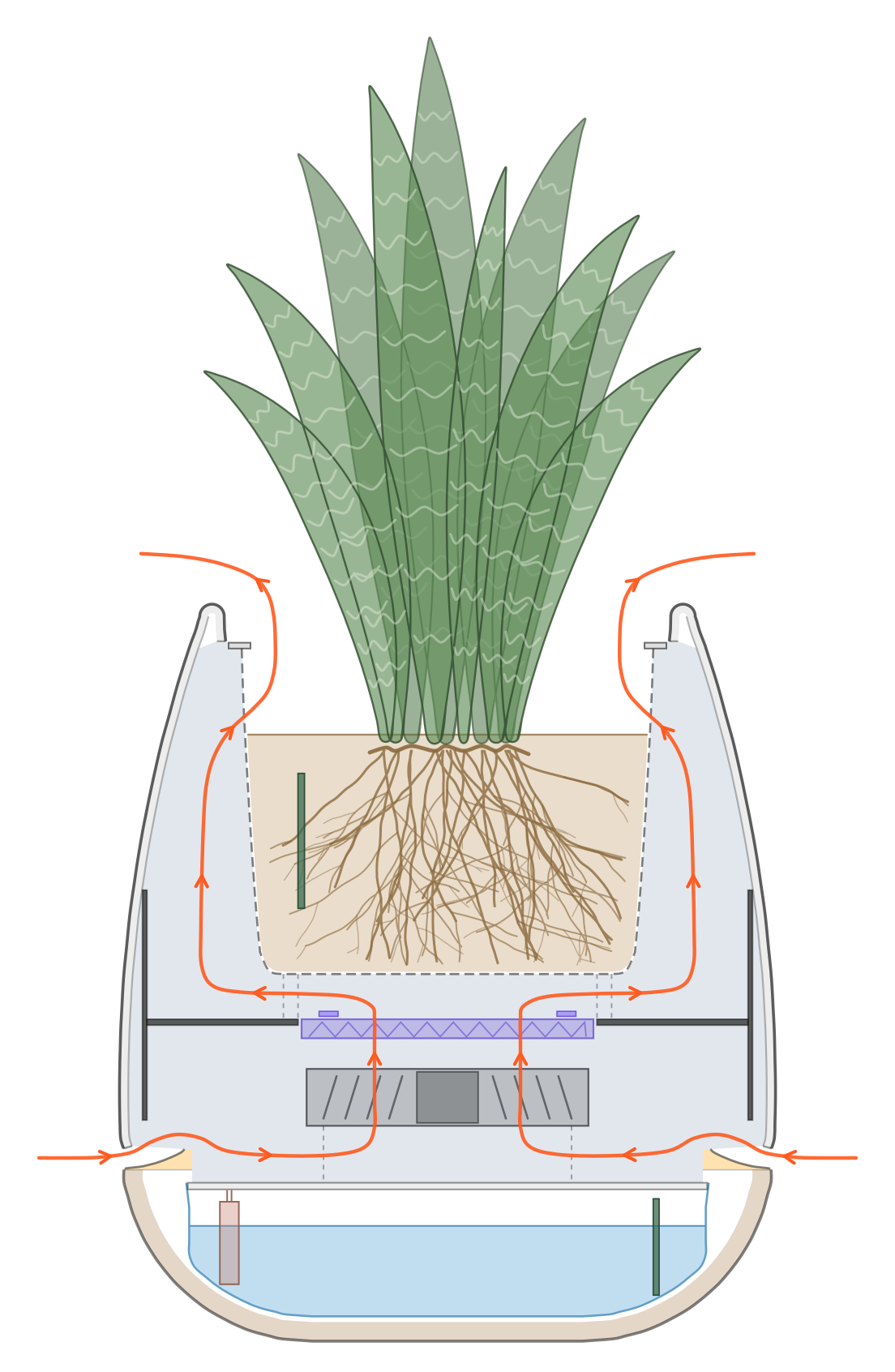
Room air is drawn in at the joint between the shell and the base, all the way round, in the lower third of the object. It meets the fan, a washable photocatalytic filter under UV light and the roots, then leaves through the ring around the plant. Nothing on the outside reads as a vent, which is the whole point of putting a purifier under a pot.
01
02
03
04
05
Base
Sensors
01/ 07Swipe
01 . INTAKE
The joint between shell and base
All the way round, in the lower third
02 . FAN
Ultra silent fan, four modes
Boost, auto, silent, off
03 . FILTER
Photocatalytic filter under UV
Washable, rinsed every 2 to 3 months
04 . AROUND THE ROOTS
Up the cavity, through the basket
Its slotted wall lets the air reach the roots
05 . OUTLET
The ring around the plant
Nothing outside reads as a vent
IN THE BASE
Reservoir and pump
4 to 6 weeks per fill
SENSORS
Six sensors
Light, air quality, temperature, humidity, soil moisture, water level
05
OUTLET
The ring around the plant
Nothing outside reads as a vent
04
AROUND THE ROOTS
Up the cavity, through the basket
Its slotted wall lets the air reach the roots
03
FILTER
Photocatalytic filter under UV
Washable, rinsed every 2 to 3 months
02
FAN
Ultra silent fan, four modes
Boost, auto, silent, off
01
INTAKE
The joint between shell and base
All the way round, in the lower third
Reservoir and pump
4 to 6 weeks per fill
Six sensors
Light, air quality, temperature, humidity, soil moisture, water level
[ THE WATER LOOP ]
Four to six weeks between two fills.
The other machine in the body is a self-watering planter. Follow the water from the base to the roots.
01
02
03
04
05
01/ 05Swipe
01 . RESERVOIR
The water sits in the base
4 to 6 weeks per fill
02 . PUMP
Lifts it to the rim
Run by what the sensors read
03 . WATERING NOZZLES
On the rim of the basket
Straight onto the soil
04 . SOIL SENSOR
In the root ball
Reads the moisture, closes the loop
05 . LEVEL SENSOR
In the reservoir
Reads what is left
One fill, drawn as a loop
The full circle is six weeks; the base lasts at least four, and the orange marks the refill window.
The owner picks the plant in the app, among 150+ supported, and tops the base up every four to six weeks.
Basket and base where they sit in the body, one scale; the air machine between them is left out. The tube is a schematic run up the side: its route inside the body is not shown.
[ THE WATER LOOP ]
Four to six weeks between two fills.
The other machine in the body is a self-watering planter. The base holds the water, a pump lifts it to nozzles on the rim of the slotted basket, a soil sensor in the root ball says when, and a level sensor knows what is left. The owner picks the plant in the app, among 150+ supported, and tops the base up every four to six weeks.
One fill, drawn as a loop: the full circle is six weeks; the base lasts at least four, and the orange marks the refill window.
Basket and base where they sit in the body, one scale; the air machine between them is left out. The tube is a schematic run up the side: its route inside the body is not shown.
01
RESERVOIR
The water sits in the base
4 to 6 weeks per fill
02
PUMP
Lifts it to the rim
Run by what the sensors read
03
WATERING NOZZLES
On the rim of the basket
Straight onto the soil
04
SOIL SENSOR
In the root ball
Reads the moisture, closes the loop
05
LEVEL SENSOR
In the reservoir
Reads what is left
[ INSIDE ]
Two machines, one body.
A purifier wants air moving through it. A self-watering planter wants water sitting still. Both had to fit under a living plant, on a side table, with no external grille to hide the airflow path.
Air purification
Optimized airflow path
Washable photocatalytic filter
UV sanitation LEDs
Ultra silent fan, four modes
Air quality sensor
Plant care
Irrigation system
Water pump and level sensor
Soil moisture sensor
Light, temperature and humidity sensors
Wi-Fi module and companion app
Air purification
Optimized airflow path
Washable photocatalytic filter
UV sanitation LEDs
Ultra silent fan, four modes
Air quality sensor
Plant care
Irrigation system
Water pump and level sensor
Soil moisture sensor
Light, temperature and humidity sensors
Wi-Fi module and companion app
[ WHAT ONMOTIO DID ]
From a brand deck to a tooled part.
Botany Labs arrived in July 2020 with a brand model, two personas and a conviction. There was no product: no volume, no internal layout, no idea whether a purifier and a watering system could share one body at that size.
We fixed the architecture everything else had to fit inside, drew the volume for injection molding, specified the materials, and produced the renders and animations the launch ran on. Five months from the first meeting to a physical prototype.
Preliminary study
Jul 2020
The preliminary study of 28 July 2020: eco-design material routes, from bio compounds and bioplastics to recycled and durable design, and four moodboards.
Product architecture
Aug 2020
Our product architecture, presented with pre-concept 1 on 17 August 2020: shell, root cavity, fan and filter stack, reservoirs in the base.
Pre-concepts
Aug 2020
Three pre-concepts presented on 17 August 2020: a soft cylinder on a light base, a ribbed square, a perforated metal square; the first went forward.
Advanced concept
Aug 2020
Pre-concept 1 refined from 26 August 2020: base width, shell dynamics and height studied in turn, leading to the final V6 design of 2 October.
Renders
Nov 2020
Scene renders briefed on 26 November 2020 and delivered from December: KORU in its color configurations, set in living rooms and bedrooms.
Prototyping
Dec 2020
Prototype files issued on 23 December 2020: top shell, structure, water tank, wood base and diffuser in CAD, with bill of materials and color configurations.
01/ 06Swipe
01
02
03
04
05
06
Jul 2020
Preliminary study
We started from what Botany Labs brought in July 2020: a brand model, a pitch deck and the CAD of their internal pot module. Our seven-page preliminary study of 28 July set out the material routes for an eco-designed object, from cork, coffee ground and rice husk compounds to PLA and PBS bioplastics, recycled materials and durable design. Four moodboards followed, biomaterials, bioplastic, metal and organic, and the client's feedback on them framed the pre-concepts.
Aug 2020
Product architecture
The architecture started from the client's internal pot module, received as CAD on 3 July 2020. We drew the whole object in section: the root ball in its cavity under the plant, the fan and filter stack below it, the reservoirs in the base, and a slot between shell and base for the air. The section was presented with pre-concept 1 on 17 August, then merged with the client's parts in one systems CAD on 1 September.
Aug 2020
Pre-concepts
From the four moodboards we modeled three pre-concepts and presented them on 17 August 2020 in a 17-page deck, with hero views, variations and the materials behind each: a soft cylinder on a light base from the bioplastic and organic boards, a ribbed square from the bioplastic board, a perforated metal square from the metal board. Pre-concept 1 went forward, and its model became the starting point of the refinement.
Aug 2020
Advanced concept
Refinement started on 26 August 2020 from the pre-concept 1 model. We studied five base widths, six shell dynamics labeled A to F and four heights, presented in a 17-page deck, then three configurations on 1 September; width 2, height H2 and dynamic B was exported for the architecture. The shell was then adjusted to the internal design through versions V5 and V6 on 1 and 2 October, and explored again as V7 in November.
Nov 2020
Renders
The render work started on 26 November 2020 with written instructions: 3D plants, pot renders, scene compositions and four color configurations with their Pantone references. Scenes 1 and 2 were exported on 3 December, and scenes 3 to 7 followed in 2021, with final edits in June. They set KORU in living rooms and bedrooms, and they are the renders the launch ran on.
Dec 2020
Prototyping
Prototyping started from a quotation dated 3 December 2020, and the smallest pot assembly reached version 9 on 19 December. On 23 December we issued the prototype files: top shell, structure, water tank, wood base and diffuser as CATIA parts and STEP exports with the product assembly, followed on 24 December by a bill of materials and two color configurations. An undercut repair followed in August 2021.
We fixed the architecture everything else had to fit inside, drew the volume for injection molding, specified the materials, and produced the renders and animations the launch ran on. Five months from the first meeting to a physical prototype.
Three calls that shaped it
Silhouette
A soft cylinder that reads as a plant pot
instead ofA vented tower with an external grille
No visible grille meant routing the air path through the body itself, under a living plant, in a volume small enough for a side table.
Filter
Photocatalytic, washable, nothing to replace
instead ofDisposable cartridges on a subscription
A filter that destroys pollutants rather than trapping them never clogs. It is what let KORU promise no consumables, and it closed off the recurring revenue most purifiers depend on.
Base
Cork or solid wood against an ABS body
instead ofA single-material shell, easier to tool
More parts, more interfaces and a visible joint that has to hold its line across five finishes. That is the price of reading as furniture instead of as electronics.
[ THE WORK ]
Concepts, sections and launch visuals.
[ WHERE IT WENT ]
It reached living rooms.
KORU ONE crowdfunded, went into production and sold for four years. In November 2025 a production unit arrived at the studio, five years after the first sketch. Most hardware concepts never get that far.
4.6 / 5
across 43 customer reviews
379 to 399 EUR
retail, five colourways
4 years
on sale after launch
“
With ONMOTIO we found the perfect Design partner for our project KORU. Clement was leading our project in a very structured, transparent and professional way. Great communication and the result speaks for itself. KORU is a piece of art. Thank you so much for you awesome work. By the way, the renders are often confused with product photos.
Friedrich Eickhoff
CEO of Botany Labs, PlantKORU
[ THE SAME TEAM ]
Bring us a problem at this stage.
This project needed several disciplines that usually sit at several different suppliers. Doing them under one roof is what stops a good concept from arriving at a factory that cannot quote it.